“2026 Public notice of land prices”
- Japanese real estate expertise

In Japan, land is assessed based on five different standards, collectively known as the “Five Assessments for One Property.”
・The Current Market Land Price
・The Officially Announced Land Price
・The Benchmarked Land Price
・The Roadside Land Price
・The Assessed Value for Fixed Asset Tax
These standards are assessed for different purposes and at different times, serving as a reference for understanding general land transaction prices.
The official land prices are announced annually by the Ministry of Land, Infrastructure, Transport and Tourism (MLIT) for designated land points as of January 1. They serve as a benchmark for general land transactions and are a representative public indicator used as a standard for public land acquisition and real estate appraisals.
On March 17, the MLIT announced the official land prices for 2026.
Nationwide land prices rose by 2.8% year-on-year (compared to 2.7% in the previous year) on average across all uses. Both residential and commercial land prices have continued to rise for the fifth consecutive year.
【Residential Land Prices】
Demand for apartments remains strong in central urban areas such as the Tokyo and Osaka metropolitan areas.
【Commercial Land Prices】
In major cities, demand for retail space and hotels is particularly strong. Office vacancy rates are also declining, and rents are on an upward trend. This has increased profitability, supporting continued land price growth. In addition, in areas undergoing redevelopment, expectations of improved convenience and vibrancy are contributing to rising land prices.
Furthermore, rising construction costs have led to soaring housing prices, which is also a contributing factor. In particular, highly convenient areas in central Tokyo—such as Konan, Akasaka, and Shibaura in Minato-ku, and Hongo in Bunkyo-ku—are all showing high growth rates. Land for housing development is scarce in central Tokyo, as developable areas are limited, and the range of price increases is expanding. Demand from wealthy individuals remains firm, and the market continues to be strong.
In addition, land prices in resort areas are rising, driven by the recovery in tourism demand, including inbound tourism. In areas such as Hakuba in Nagano Prefecture and Furano in Hokkaido, increases of over 30% have been observed.
◆Change Rate by Prefecture
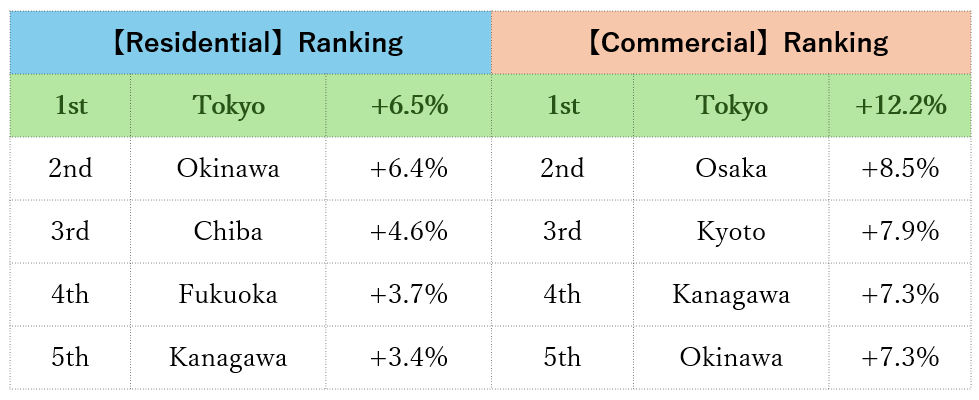
*Source: MLIT / Average Year-on-Year Change Rate by Prefecture and Use Type
◆Change Rate Ranking (Top 5) – Tokyo 23 Wards
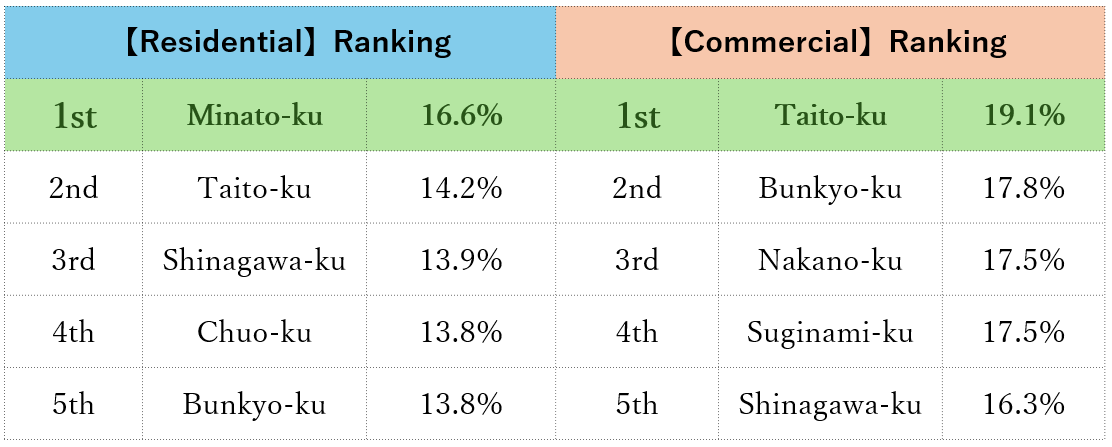
*Source: Tokyo Metropolitan Government Official Website / 2026 Overview of Officially Announced Land Price (Tokyo)
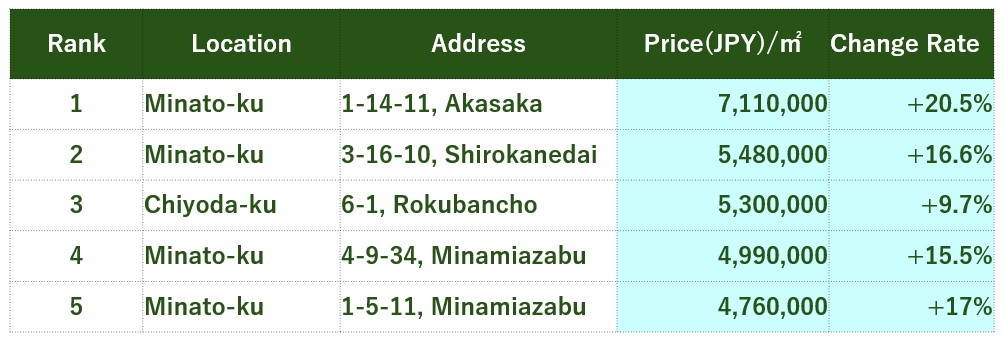
◆Price Ranking (Top 5 Locations) of Designated Points – Tokyo
【Residential】Ranking
【Commercial】Ranking
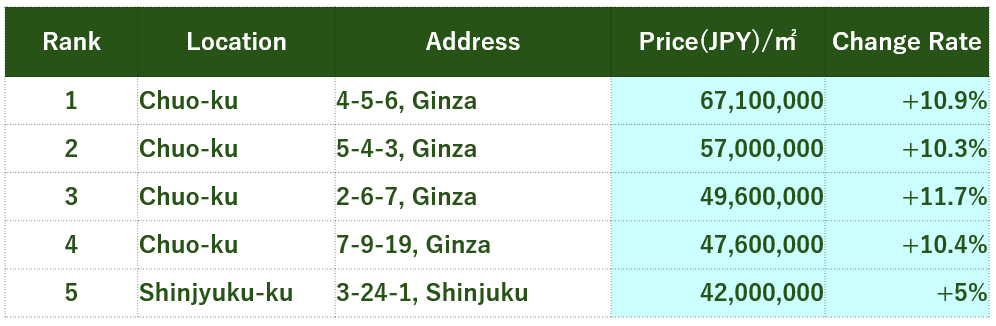
*Source: Tokyo Metropolitan Government Official Website / 2026 Overview of Officially Announced Land Price (Tokyo)
Amid the continuing rise in land prices, capital is increasingly concentrating in a limited number of central urban areas. It is expected that wealthy individuals and investors will continue to focus on these areas. In particular, Tokyo and Kanagawa, which offer convenient transportation and a strong living environment, are likely to continue attracting attention as areas with stable demand. A long-term perspective is recommended when identifying investment opportunities in such areas.
 Availability
  Enquiry